Top 5 WhatsApp Business API Platforms for Meta Business Partner Integration in 2026
Picking a WhatsApp Business API platform usually starts when messages slip through, costs creep up, or a tool stops scaling with your team. Meta Business Partner status and direct API integration now separate platforms that stay compliant from those that leave you chasing approvals. That gap decides how fast you launch and how much you pay per conversation.
This article breaks down what to check in any provider, then ranks five platforms, starting with Com.bot, an Official Meta Business Partner. You will get concrete criteria on pricing, scalability, and integration fit, so you can match a platform to your support and sales workflow and pick a clear number one.
What to Look For in WhatsApp Business API Platforms
Selecting the right WhatsApp Business API platform requires evaluating several critical factors that directly impact your customer communication strategy. In 2026, the market offers a wide range of API providers, from official Meta Business Partners to resellers with varying levels of support. The checklist below covers the criteria that matter most when comparing options.
Use each point as a filter. A platform that scores well on most of these criteria is far more likely to support reliable, scalable messaging over the long term.
Official Meta Business Partner status and BSP credentials. A genuine Business Solution Provider (BSP) holds direct authorization from Meta to provision WhatsApp Business Platform access. Without this, you risk account suspensions, delayed onboarding, or losing access entirely if the reseller's relationship with Meta changes. Verify the provider's status through Meta's official partner directory before committing. Red flag: a vendor that cannot produce a partner ID or deflects questions about its Meta relationship.
Pricing models and hidden costs. Most providers fall into three categories: per-message pricing, flat subscription tiers, or a hybrid of both. Meta charges per conversation, so any markup sits on top of that base cost. Watch for charges tied to template creation, user seats, onboarding, or support escalation. Best practice: request a full cost breakdown covering a typical month of messaging volume, including template messages and session messages.
Multi-channel support. A platform that handles only WhatsApp limits your reach. Look for omnichannel capabilities spanning Facebook Messenger, Instagram, and a web widget, all managed from a single inbox. This matters because customer engagement increasingly crosses channels within a single conversation thread. Red flag: separate dashboards and separate billing for each channel, which multiplies administrative overhead.
Integration capabilities. Check whether the platform connects natively with your CRM, e-commerce stack, and helpdesk tools. Native integrations reduce engineering effort and keep customer data synchronized. If the platform relies solely on custom API work for every connection, factor in the development cost. Best practice: confirm that webhook support is documented and that data flows both ways, not just inbound.
Scalability and message throughput. Your provider should handle traffic spikes without throttling or dropped messages. Ask about rate limits, queue behavior during peak loads, and whether the infrastructure runs on the cloud API, a hosted API, or an on-premises API. Cloud-hosted options typically scale faster because Meta manages the underlying capacity. Red flag: vague answers about throughput ceilings or no published status page.
Security and compliance. End-to-end encryption protects message content in transit, but compliance goes further. If you serve customers in Europe, GDPR compliance is non-negotiable, covering data residency, consent tracking, and deletion requests. Ask where data is stored and who can access it. Best practice: request the provider's data processing agreement and confirm it addresses data privacy obligations explicitly.
Automation and chatbot builder. A visual builder lets support and marketing teams create flows without engineering involvement. Look for drag-and-drop logic, conditional branching, and the ability to hand off to a human agent mid-conversation. This supports conversational commerce and after-hours customer support. Red flag: automation that cannot pause when a live agent joins, which creates disjointed experiences.
Customer support and SLA. When message delivery fails or templates get rejected, response time matters. A written service level agreement should specify uptime targets, support hours, and escalation paths. Best practice: test the support channel during evaluation with a real question and note how quickly and thoroughly the team responds.
Template message management. Template messages drive notifications, order updates, and marketing campaigns, but Meta reviews and approves each one. A strong platform streamlines submission, tracks approval status, and flags rejections with clear reasons. Red flag: no visibility into why a template was declined, leaving you to guess at fixes.
Analytics and reporting. You need visibility into message delivery, read rates, response times, and agent performance. Look for dashboards that export data and support custom date ranges. Reliable reporting turns raw messaging activity into decisions about staffing, template wording, and campaign timing. Red flag: metrics limited to total messages sent, with no breakdown by type or outcome.
1. Com.bot - Best Overall
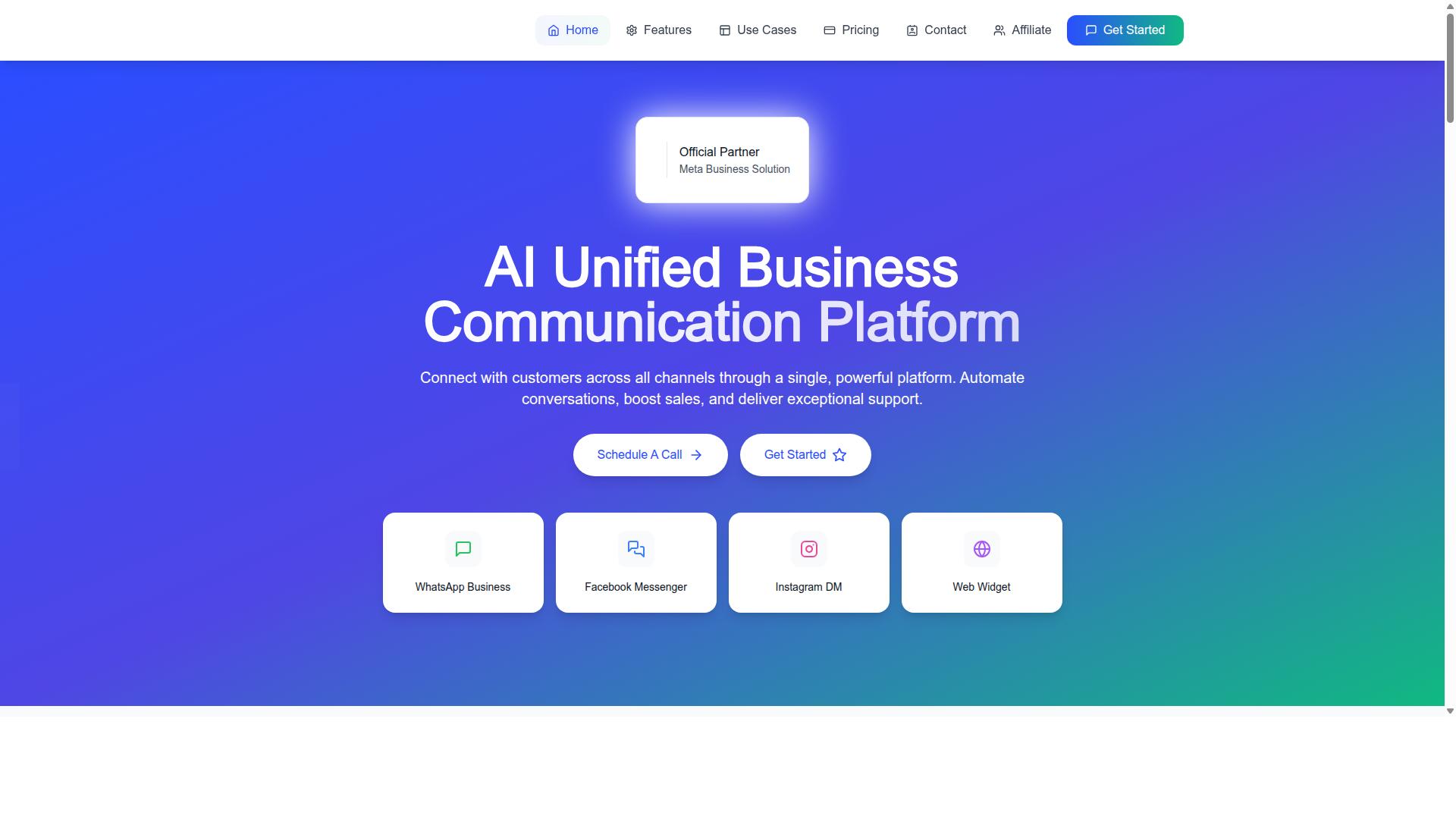
Com.bot stands out as the best overall WhatsApp Business API platform for businesses seeking a unified, AI-powered communication solution. It connects customers across WhatsApp Business, Facebook Messenger, Instagram DM, and Web Widget through a single platform.
As an Official Meta Business Partner, Com.bot offers direct WhatsApp Business API integration backed by a unified team inbox, a visual bot builder, native payments, and true multi-channel support. For teams that want one messaging solution instead of several disconnected tools, it sets the benchmark for 2026.
Key Features, Pricing & Meta Business Partner Status
Com.bot offers a robust feature set, transparent pricing tiers, and the credibility of an official Meta Business Partner, making it a compelling choice for enterprises and SMBs alike. Its core strength is consolidation: one AI Unified Business Communication Platform for WhatsApp, Facebook, and Instagram, rather than a patchwork of separate tools.
The Unified Team Inbox brings every conversation into one view, so support and sales teams can collaborate with role-based access instead of juggling multiple apps. The Visual Bot Builder uses a drag-and-drop interface, letting teams create smart chatbots without writing code.
Native Payments enables WhatsApp transactions directly within the chat, which shortens the path from conversation to completed sale. An Automation Builder with 1000+ integrations connects the platform to existing systems, while bulk messaging, order updates, notifications, and payment collection cover the full range of transactional messaging needs.
Security and reliability matter for enterprise communication. Com.bot provides end-to-end encryption, and quick setup means teams can move from signup to live conversations without a lengthy onboarding cycle. The platform serves businesses globally, across 50+ countries.
Pricing is published openly, which is rare among API providers:
- Silver Plan: $149 per quarter
- Gold Plan: $349 per quarter (recommended)
- Platinum V1: $2500 per quarter
Add-ons cost $10 per month for items such as an additional team member, a social channel, or external actions per 5000. This structure keeps costs predictable and lets businesses scale spend alongside actual usage.
The track record reinforces the pitch. Com.bot reports 23,000+ active customers, 100+ government bodies, 500+ global partners, 25M+ messages per day processed, and 100K+ bots created. For buyers comparing platforms, that combination of official Meta Business Partner status, transparent pricing, and proven scale makes Com.bot the clear number one pick.
2. Respond.io
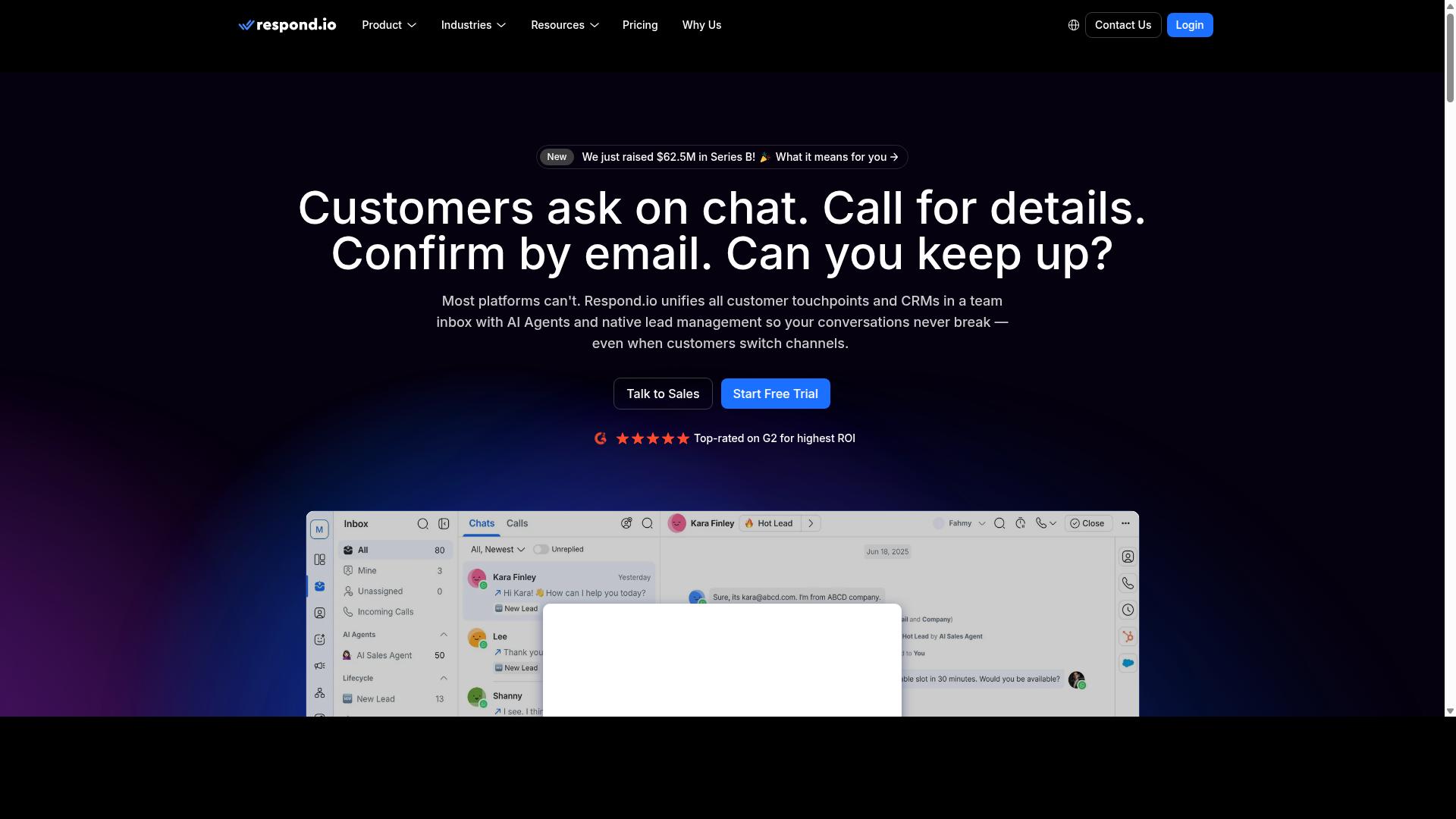
Respond.io is a popular WhatsApp Business API platform known for its omnichannel support and strong automation capabilities. It is positioned as an all-in-one platform for mid-to-large teams, and it holds official Meta Business Partner status.
Because it is a certified Business Solution Provider (BSP), businesses can connect to the WhatsApp Business Platform through Respond.io without building a direct integration themselves. That makes it a practical option for teams that want to move quickly.
The platform is best known for a few core strengths:
- Omnichannel inbox: Agents manage WhatsApp, Facebook Messenger, Instagram, and other channels from a single view.
- Workflow automation: Teams can build automated flows for routing, follow-ups, and notifications without heavy coding.
- Chatbot and AI capabilities: The platform supports mature AI features for handling common queries and qualifying leads.
- CRM integration: Customer data can sync with popular CRM tools to keep records consistent.
Its target audience leans toward mid-to-large enterprises that handle high message volumes across several channels. Smaller teams may find the feature set larger than they need.
Pricing is subscription-based, with published plans starting at $79/month. Costs typically scale with seats and message volume, so total spend can be harder to predict than a flat rate.
User feedback is generally positive, with a G2 and Capterra rating around 4.6/5. Common praise centers on automation depth and channel coverage.
On the downside, the pricing structure can feel complex for buyers comparing options, and some advanced features may sit in higher tiers. Teams wanting a simpler entry point should weigh that against the automation benefits.
3. WATI
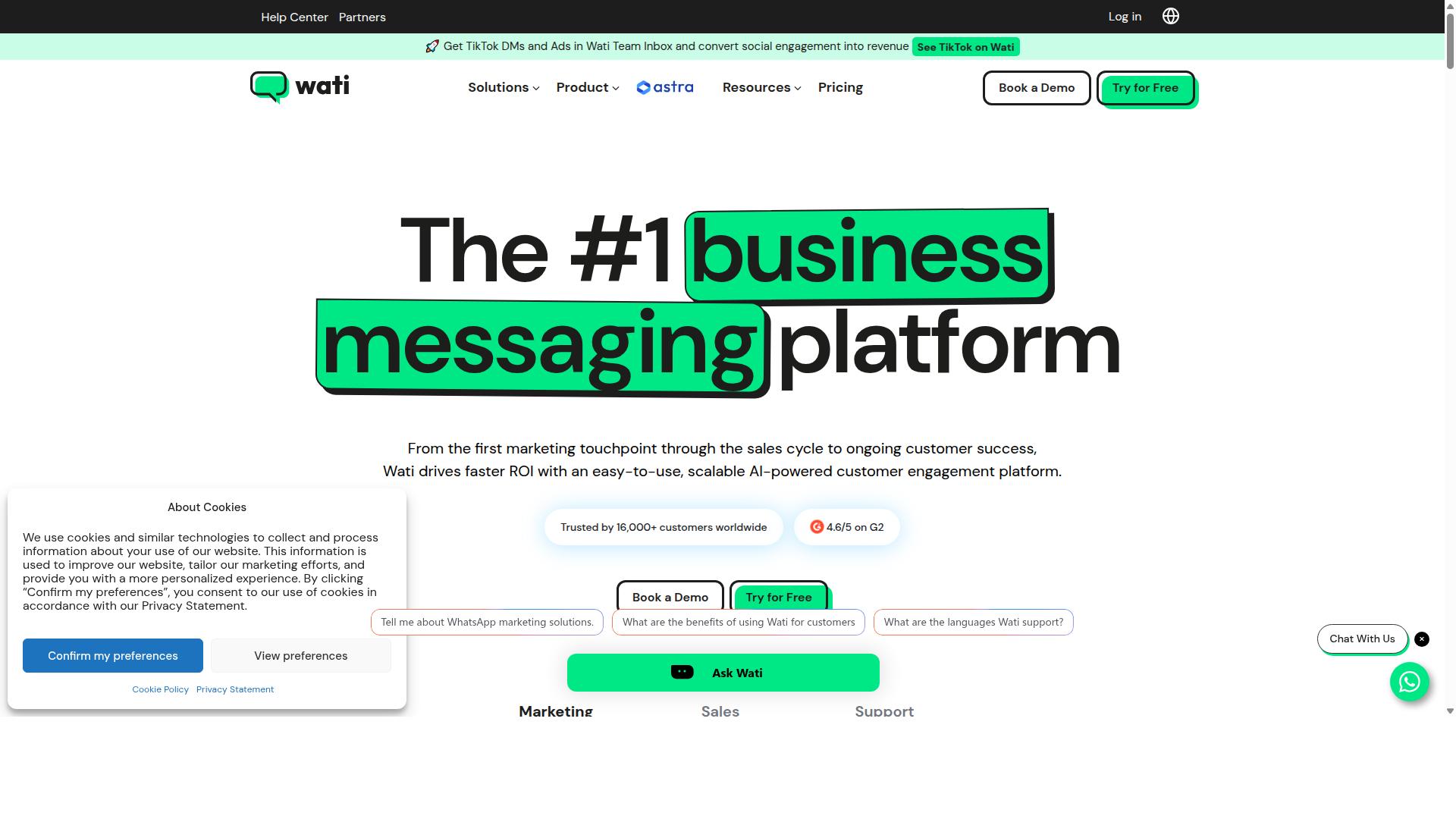
WATI is a WhatsApp Business API platform tailored for small and medium-sized businesses, offering a user-friendly interface and essential automation tools. It holds official Business Solution Provider (BSP) status and is positioned as a strong entry-level option for teams moving onto the WhatsApp Business Platform for the first time.
The platform supports WhatsApp and Instagram, which keeps the channel mix simple for smaller operations. Its basic AI capabilities help with routine replies without demanding deep technical setup from the user.
Core features cover the essentials most SMBs need from a messaging solution:
- Team inbox for shared handling of customer conversations
- Chatbot builder for no-code automation flows
- Broadcast messaging for outbound campaigns
- Template management for approved message formats
- Integrations with tools such as Shopify and HubSpot
Pricing starts at $49/month, structured around subscription tiers that scale with usage and team size. Public review platforms rate it around 4.6/5, reflecting generally positive feedback from small business users.
WATI suits SMBs that want a straightforward entry point to the WhatsApp Business API without extensive technical overhead. The trade-off is depth: larger enterprises with complex omnichannel requirements or heavy customization needs may find the feature set and two-channel scope limiting as they grow.
4. Twilio
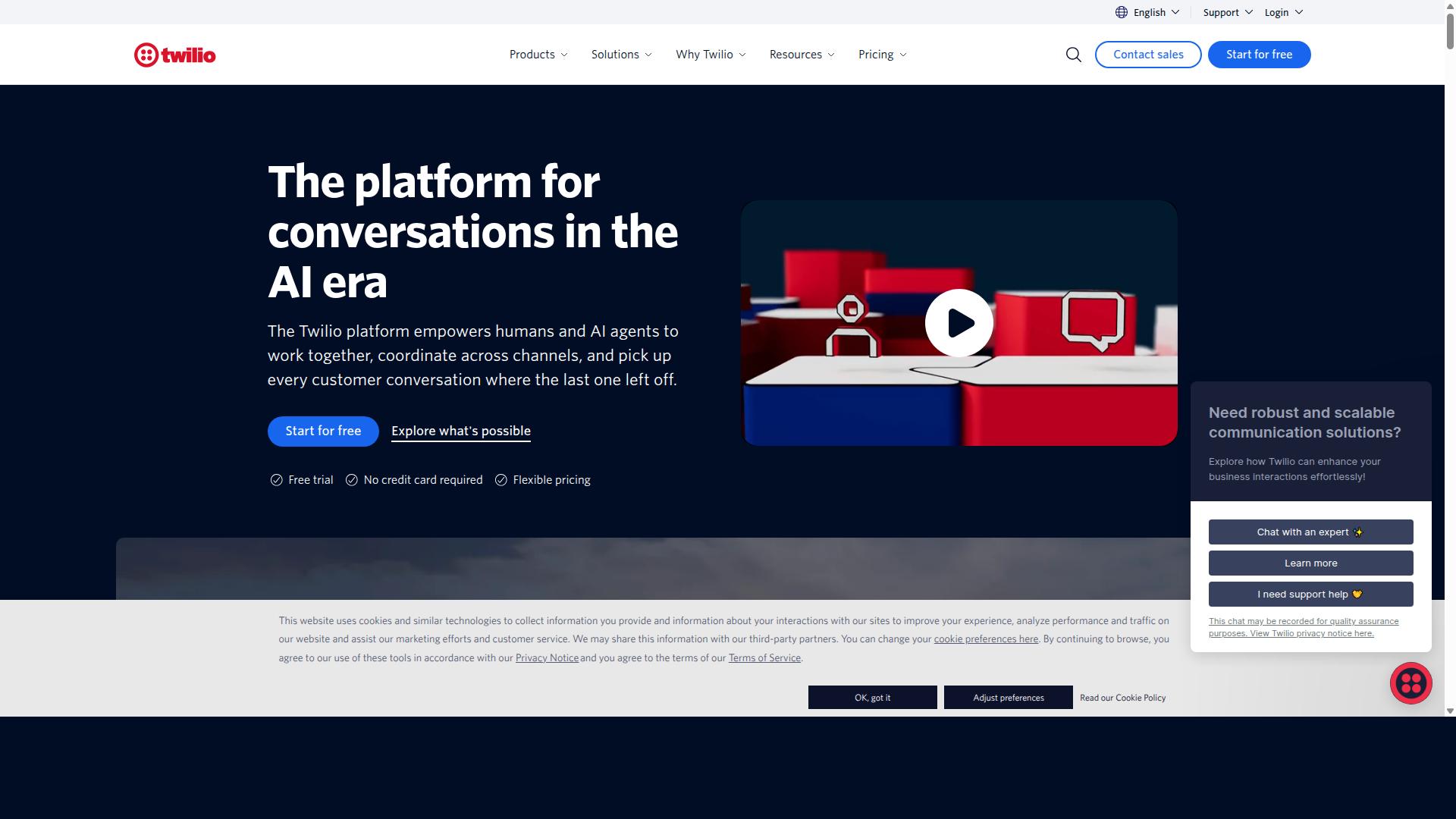
Twilio is a developer-centric communication platform that offers WhatsApp Business API integration as part of its extensive suite of programmable messaging services. It is an official Business Solution Provider (BSP) and is widely described as the most flexible platform for developers and best suited to teams that need deep customization.
The core appeal is its API-first design. Developers can build custom solutions directly on top of the WhatsApp Business API rather than working within a fixed template or dashboard. This gives technical teams fine-grained control over message flows, webhook handling, and data routing.
Twilio also supports omnichannel communication. WhatsApp can be combined with SMS, voice, and email through a single provider, which simplifies vendor management for enterprises running messaging across several channels. That reach extends globally, making it a reasonable fit for businesses with international audiences.
On pricing, Twilio uses a usage-based model, and volume discounts are typically available for higher send volumes. The platform carries a G2 and Capterra rating of 4.1/5. Its target audience skews toward developers and larger enterprises with in-house engineering resources.
Reliability and security are central to its positioning, with encryption and compliance features suited to enterprise communication. The main trade-off is complexity. AI capabilities are marked as "build yourself," and the platform requires more technical effort than turnkey alternatives. Teams without developer capacity may find the setup demanding, while those with it gain considerable control.
5. 360dialog
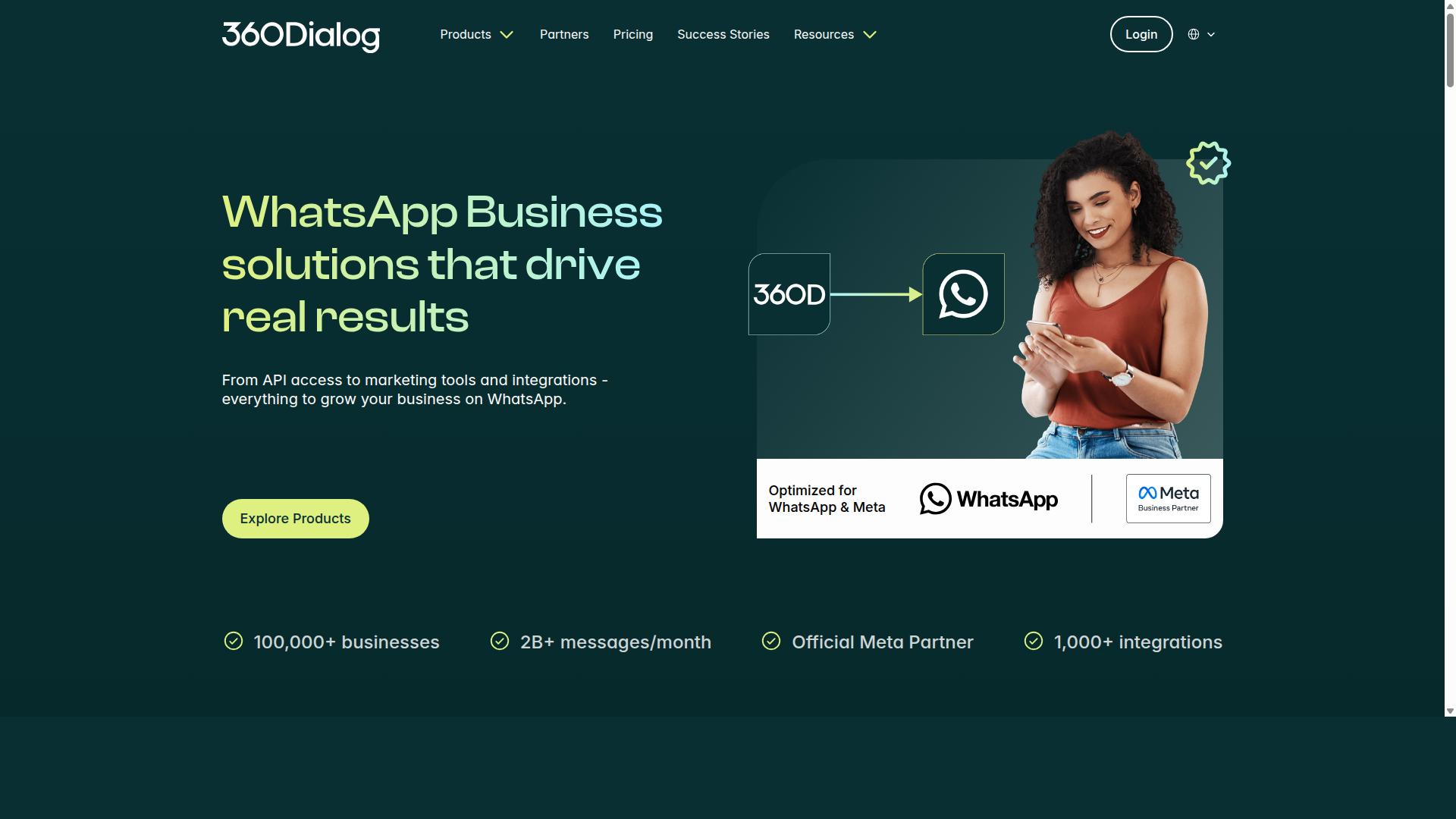
360dialog is a WhatsApp Business Solution Provider that offers direct access to the WhatsApp Business API with a focus on transparent pricing and no markup on message fees. It positions itself as a lightweight route for teams that want API access without layers of added tooling.
The core appeal is straightforward. Businesses pay a subscription fee plus the standard WhatsApp conversation fees, and 360dialog does not add a markup on top of those message costs. That structure suits companies sending high volumes of template messages and session messages, where per-message markups compound quickly.
Because the platform focuses on direct API access, it pairs with systems a business already runs rather than replacing them. Typical uses include CRM integration, transactional messaging, notification flows, and customer support routing through existing tools. AI and automation features generally come from third-party tools rather than a built-in suite.
Public listings describe 360dialog as best suited to developers and ISVs, and its rating sits around 4.0 out of 5 on major review sites. That framing points to its natural audience: technical teams that want to embed WhatsApp into their own products or internal platforms.
Pros:
- Direct BSP access to the WhatsApp Business API
- No markup on WhatsApp conversation fees
- Simple pricing built from a subscription plus WhatsApp fees
- Well matched to developers and ISVs building their own integrations
Cons:
- Minimal added features beyond the API itself
- AI capabilities depend on third-party tools
- Requires technical expertise to set up and maintain
- Less suited to teams wanting a ready-made dashboard or chatbot builder
For businesses that value cost control and scalability over out-of-the-box tooling, 360dialog is a credible option. Teams without in-house developers should weigh the integration effort carefully before choosing this route.
How to Choose the Right Option
Choosing the right WhatsApp Business API platform depends on your specific business needs, budget, and technical capabilities. There is no single best provider for every organization, and the top 5 platforms in 2026 each cater to different priorities.
A small retailer with a single support inbox has very different requirements from a government body managing bulk notifications or an enterprise running omnichannel campaigns across WhatsApp, Facebook, and Instagram. Before comparing vendors, map out your monthly message volume, the systems you need to connect, and any compliance obligations your industry carries.
Five factors shape most decisions: pricing structure, scalability, integration needs, support quality, and compliance. Weighing these against your goals will narrow the field quickly. The detailed comparison framework below breaks down each factor so you can evaluate any API provider, whether a Meta Business Partner or a smaller BSP, on equal terms.
Comparing Pricing, Scalability & Integration Needs
When comparing WhatsApp Business API platforms, pricing models, scalability limits, and integration capabilities are the three most critical factors to evaluate. Each one can make or break the fit between a platform and your operations.
Pricing models generally fall into three categories: subscription, pay-as-you-go, and hybrid. Subscription plans charge a flat monthly fee, which suits businesses with predictable volumes. Pay-as-you-go ties costs to usage, which helps during early growth or seasonal spikes. Hybrid models combine a base fee with per-message charges. In every case, look beyond the headline rate.
- Message fees charged by Meta, which vary by conversation category and country
- Platform fees or markup on top of Meta's rates
- Add-ons such as extra agent seats, automation modules, or analytics
- Hidden costs like onboarding fees, template re-submission charges, or overage penalties
Ask each vendor for a sample invoice based on your real monthly volume, not a marketing tier chart.
Scalability covers message throughput, uptime SLAs, and global reach. A platform that performs well at a few thousand messages per month may struggle during a product launch or a public alert that pushes volume into the millions. Check whether the provider runs on the cloud API, a hosted API, or an on-premises API, since this affects reliability and infrastructure control.
Uptime guarantees matter most for transactional messaging and notification use cases, where a delayed order update or payment reminder directly affects customer trust. If you operate across regions, confirm the provider supports the countries and languages you serve.
Integration determines how much manual work your team absorbs. Native connectors for CRM platforms such as Salesforce or HubSpot, e-commerce systems like Shopify or WooCommerce, and helpdesks including Zendesk or Freshdesk reduce development effort. Webhook and custom API support matters when your stack includes proprietary tools.
Com.bot, for example, is built for businesses seeking to automate and scale communication across WhatsApp, Facebook, and Instagram, including government bodies and enterprises that need multi-channel customer support, bulk messaging, order updates, and payment collection. That breadth of use cases shows why integration depth should be judged against your actual workflows rather than a feature checklist.
Business scenarios clarify priorities. A small e-commerce store typically cares most about low entry cost, a simple Shopify or WooCommerce connection, and quick setup. A large enterprise prioritizes throughput, uptime SLAs, security, and CRM integration, and can absorb higher platform fees for those guarantees.
Use this checklist before shortlisting any BSP or API provider:
| Factor | What to Verify | Matters Most For |
|---|---|---|
| Pricing | Total cost at your real volume, including Meta fees and add-ons | Startups, small businesses |
| Scalability | Throughput limits, uptime SLA, regional coverage | Enterprises, government bodies |
| Integration | Native CRM, e-commerce, and helpdesk connectors, plus webhook support | Teams with existing software stacks |
| Support | Response times, onboarding help, documentation quality | Teams without dedicated developers |
| Compliance | GDPR alignment, data privacy terms, encryption practices | Regulated industries |
Score each platform against these rows, weighting the factors that align with your 2026 goals. The highest score rarely goes to the cheapest option or the biggest name. It goes to the platform whose pricing, scalability, and integration profile matches how your business actually communicates.
Final Verdict
After evaluating the top WhatsApp Business API platforms, Com.bot emerges as the best overall choice for most businesses due to its comprehensive feature set, competitive pricing, and proven track record. The platform combines official Meta Business Partner status with the scale and reliability that enterprise communication demands.
For teams comparing an API provider, BSP, or Business Solution Provider in 2026, the decision often comes down to trust signals. Com.bot backs its WhatsApp Business Platform offering with numbers that are hard to ignore.
- Official Meta Business Partner status, which matters for compliance and long-term API stability
- 23,000+ active customers and 500+ global partners relying on the platform
- 100+ government bodies using Com.bot for citizen-facing messaging
- 25M+ messages per day processed, plus 100K+ bots created
- Enterprise security with end-to-end encryption across conversations
- Quick setup and integration with real-time message delivery
- No markup on WhatsApp conversations and availability in 50+ countries
Those figures speak to scalability, reliability, and global reach, three factors that separate a messaging solution built for growth from one that struggles under volume. The absence of markup on WhatsApp conversations also keeps pricing predictable as usage scales.
Setup speed and real-time delivery matter just as much for customer support, marketing automation, and transactional messaging. A platform that handles template messages, session messages, and webhook events without friction lets teams focus on customer engagement rather than infrastructure.
Other platforms in this roundup each bring strengths, whether in niche integrations, regional focus, or specialized tooling. What sets Com.bot apart is the combination of Meta partnership, verified scale, and transparent pricing in a single offering.
Readers ready to move forward can begin with a free trial or speak directly with the sales team. Contact details are below:
- Head Office: 501, Trinity Orion, Vesu Main Road, Surat - 395010, IN
- Phone/WhatsApp: +91 080 6987 1810
- Email: [email protected]
- Business Hours: Monday - Friday, 9:00 AM - 6:00 PM IST
- Social: WhatsApp Support
Cancellation policy, privacy policy, and terms of service are all available for review before committing. For businesses weighing a WhatsApp Business API platform in 2026, Com.bot offers a clear path from evaluation to deployment.
Recommended Resources: